
Clemmons City Directory Runs and Repositories
Clemmons is served by the historical Winston-Salem and Forsyth County directory shelf, not by a verified continuous Clemmons-only run. The Forsyth city-directory bibliography identifies local holdings from 1898 to the present and selected digitized volumes reaching 1879–80. For a rural address, try Clemmons, Clemmonsville, a nearby post-office name, and the county gazetteer. An absence may reflect rural coverage, an abbreviated listing, or a suburban section rather than an empty household.
The DigitalNC record for the 1884 directory shows one of the early digitized routes into the broader Forsyth collection.
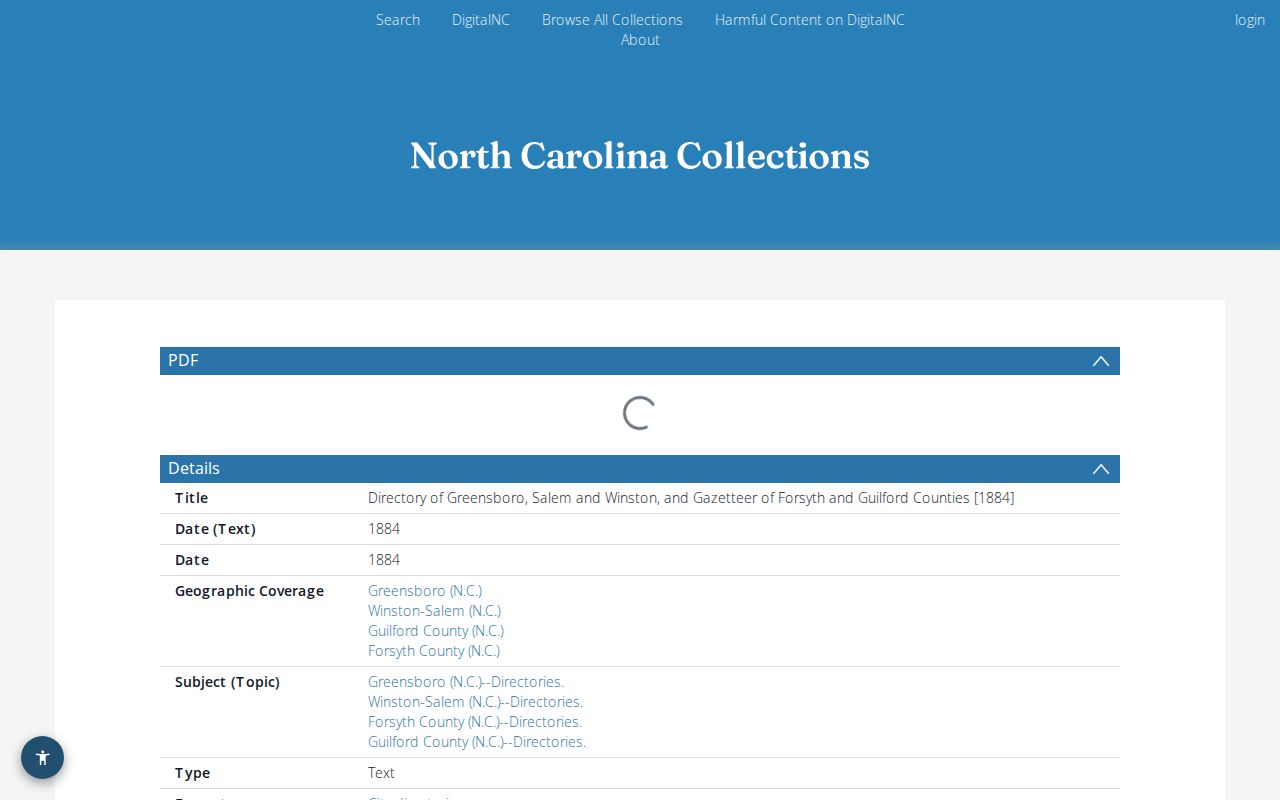
That record is a starting point for a particular edition, while the library shelf and bibliography establish the wider run.
| Collections | Years | Where Held | Access |
|---|---|---|---|
| Forsyth city-directory shelf | 1898 to present | Forsyth County Public Library North Carolina Room | Library research collection |
| Selected digitized directories | 1879–80 through 1920–23, selected years | DigitalNC and cited Internet Archive routes | Online record pages and scans |
| Reverse, criss-cross, and street-guide material | At least 1940s examples documented | North Carolina Room and DigitalNC scans | Address-to-name route; exact run varies |
| Newspaper index and microfilm | Title-specific; some microfilm exceeds 100 years | North Carolina Room | Index lead followed by page or microfilm research |
These are dated publications and research tools, not a current official list. Their coverage changes by publisher, section, and period.
Clemmons City Directory Publishers by Era
Publisher names help explain why a search changes from volume to volume. DigitalNC identifies the 1884 book as an Inter-State Directory Company volume for Greensboro, Salem, Winston, and a gazetteer. Turner & Co. produced the 1889–90, 1891–92, and 1894–95 records. Walsh’s volumes include 1902–03 and 1904–05. The 1910 and 1920 records are tied to Ernest H. Miller or Piedmont Directory Company, while the 1930 record identifies Miller and Commercial Service Company.
Hill’s directories appear in the documented 1940, 1943, 1949–50, and 1951 records. A later volume can have a numerical telephone portion, an alphabetical index, and a street-and-avenue guide, so it should not be read like an earlier alphabetical book. Keep the publisher and edition with every transcription. It is the safest way to distinguish a change in format from a change in the household.
Note: A title can cover Winston-Salem and Forsyth County while still omitting or relabeling a rural Clemmons address.
Clemmons City Directory Research Desk
The Forsyth County Public Library North Carolina Room is the main local room for historical residents. Its materials include city directories, local and state history, genealogy resources, family files, newspapers, photographs, and vertical files. It also lists online research services such as Historic NC Digital Newspapers and ArchiveGrid. Some genealogy services are available at library branches or may require a library-card login, so access should be checked with the library rather than assumed from an old listing.
The Clemmons Branch provides local context through its Village historical file and historic photographs. Published branch information gives a phone number of 336-703-2920 and hours of Monday through Thursday 9–8, Friday 9–6, and Saturday 10–5. The branch opened in 2021; the first Clemmons library service dates to 1964.
A visit to the Clemmons Branch library page shows the local branch associated with this Clemmons city directory research route.
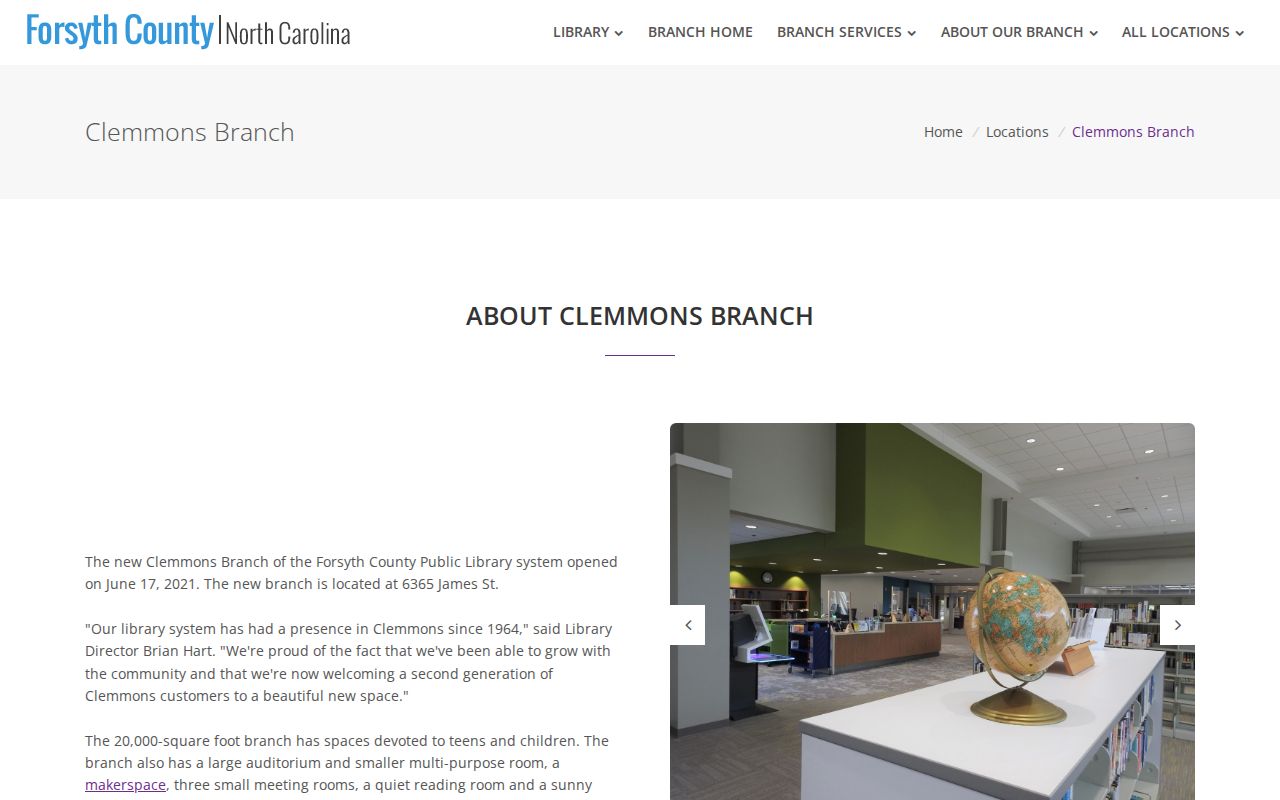
Use the branch for local context, then ask the North Carolina Room about the specific volume, microfilm, photograph, or index needed.
How a Clemmons City Directory Entry Reads
Walsh’s 1904–05 Forsyth volume shows how compressed an entry can be. It may give the indexed name, a title such as “Miss,” a spouse in parentheses, an occupation abbreviation, a business or institution reference, a residence marker, a numbered street, and a section code. “r same” means the residence matches the place just named. A spouse in parentheses can help connect a household, but it is not a legal relationship record.
| Indexed name | The printed surname and given name, sometimes with a title or gender marker. |
|---|---|
| Parenthetical name | A spouse or partner name when the publisher included one. |
| Occupation abbreviation | A compressed description that must be read with the volume’s own key. |
| Residence line | The r marker, address, street, and any local section code. |
| Additional notation | “r same,” widow wording, or a business/institution reference when printed. |
- Criss-cross directory
- A reverse section arranged by street and number, used to move from an address to a listed name.
- Householder index
- An alphabetical route that generally emphasizes the named household contact rather than everyone connected to an address.
- Abbreviation key
- The publisher’s front-matter list of short forms. Photograph or transcribe it before expanding an entry in notes.
One inspected Walsh entry reads, “ABBOTT ROBERT (Mattie), mach, r 213 Water (S).” It demonstrates the name, parenthetical spouse, occupation abbreviation, residence marker, street number, and section code in one line. Walsh’s front matter defines such terms as r for residence, rd for road, ave for avenue, and widow. Preserve the printed wording first. A later note can explain an abbreviation without silently changing what the directory said.
Clemmons City Directory Geography
The 1904–05 Walsh volume uses the section codes (W), (S), (S S), (C), and (W T) for Winston, Salem, Southside, Centerville, and Waughtown. Those labels are not modern Clemmons municipal boundaries. A person associated with the present village may be filed under another community, a rural section, or a post-office label. Search the old spelling as printed instead of translating it into a modern boundary.
This mismatch is why an address search needs more than one version of a name. Compare the street guide, legal description, map, and edition date before declaring a house missing from the record. The Clemmons Historical Society’s DigitalNC interview-notes record also preserves local street and community context from about 1945–1950.
The Clemmons historical-notes record at DigitalNC supplies a local-history companion to the city directory volumes.
Oral-history notes can suggest names or roads to test in the printed directories, but they should be cited as a separate source.
Online Clemmons City Directories
DigitalNC makes several named Forsyth editions easier to inspect from home or at the library. The collection includes the 1902–03 and 1904–05 Walsh records, as well as the 1910, 1920, 1930, 1940, 1943, 1949–50, and 1951 records documented in the bibliography. The scan does not replace the shelf: a digitized edition may be incomplete, have a hard-to-read page, or lack the companion volume needed for an address route.
The DigitalNC 1910 directory record is a direct example of the later publisher era.
Save the record-page URL, edition year, and printed page with each finding so another reader can check the scan.
The library’s online resources listing identifies the changing set of databases and access conditions available through Forsyth County Public Library.
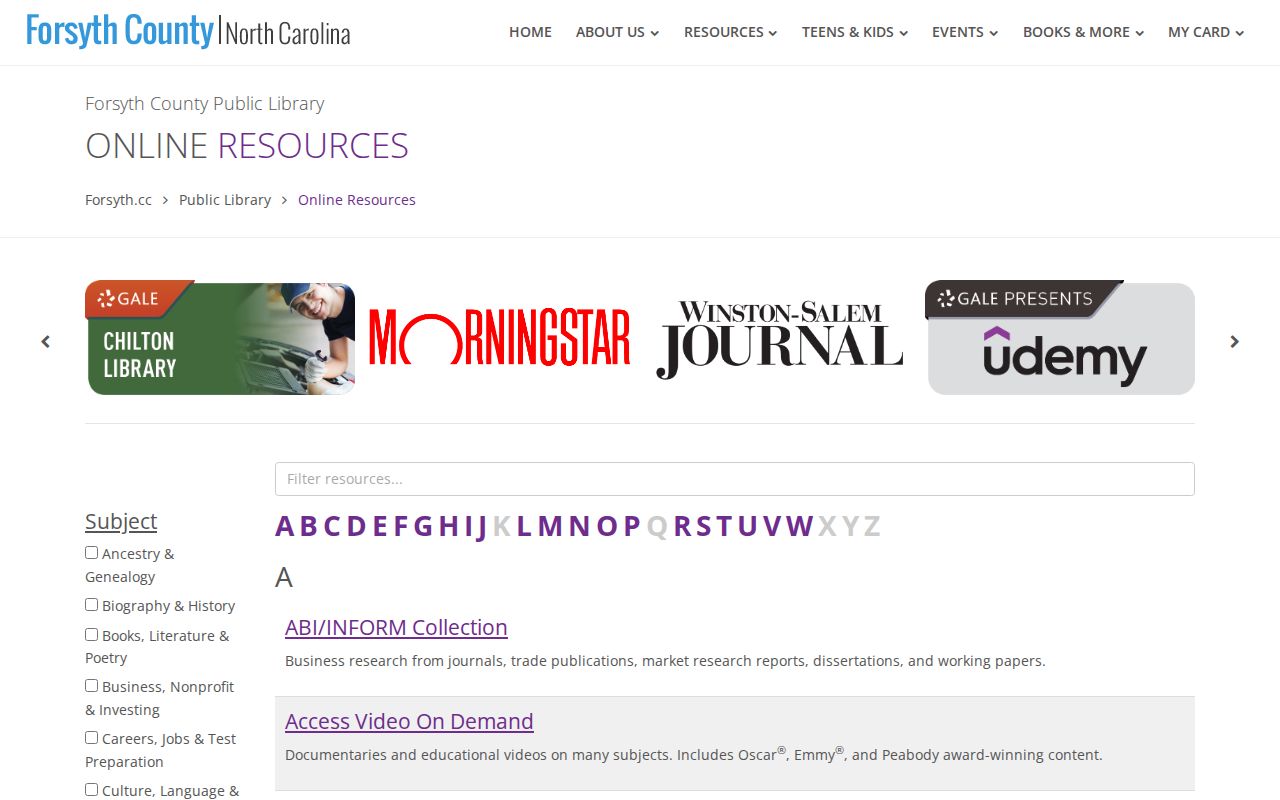
Use the library’s current listing to confirm whether a database is branch-only, card-based, or otherwise limited before making a research trip.
Tracing a Clemmons Directory Household
A household trail becomes stronger when each directory entry is placed between other dated records. Start with an exact surname or current address, then record every variation rather than choosing one version too early. The historical collection itself is the best place to see how a street guide and alphabetical entry work together.
- Find the surname or street number in one edition and record the edition year, printed page, spelling, and section code.
- Read the alphabetical line closely for a parenthetical name, residence wording, and address.
- Check nearby editions in both directions, including nearby community or post-office names for rural Clemmons research.
- Pair the intervening directory years with the matching federal census release to compare a directory snapshot with a decennial household snapshot.
- Use the newspaper index, deed trail, probate file, church record, or cemetery lead to test why an entry begins, ends, or changes.
A one-year absence can mean a move, an unlisted rural address, a spelling change, or a gap in publication. Census schedules are released under the 72-year rule, and neither a census nor a directory stands in for a deed or certificate.
Forsyth Directory Formats Through Time
Forsyth County’s record history gives useful context for reading directory-era research. County instruments began with county formation in 1849. The Register of Deeds describes hand-copied books from 1849–1904, typed records from 1904–1929, microfilm beginning in 1954, integrated vital indexes in 1962, and computerized indexes in 1965. The progression is a reminder to expect different handwriting, abbreviations, and access methods as the search moves backward.
| 1849 | Forsyth County formed from Stokes County; the local deed-book context begins. |
|---|---|
| 1849–1904 | Hand-copied Register of Deeds books create an older reading and index challenge. |
| 1904–1929 | Typed deed books overlap the Walsh and later directory eras. |
| 1954–1965 | Microfilm, integrated vital indexes, and computerized indexes change the records path. |
No official records-loss event was verified for the Forsyth sources reviewed. A missing digital page may instead mark an image boundary, an index issue, or a volume that requires in-person research.
Clemmons Historical Sources Beyond Directories
The North Carolina Room’s newspaper index covers the Winston-Salem Journal, The Sentinel, Union Republican, Winston-Salem Chronicle, and Clemmons Journal. An index hit can point to an obituary, marriage announcement, civic notice, address reference, or community report, but it does not guarantee the full text. Request the microfilm page or a reproduction under the library’s current policy.
Sanborn maps add building and street context for places they cover. Library of Congress Winston-Salem map material is part of runs that include 1885, 1890, 1895, 1900, 1907, 1912, 1917, 1950, and 1957–58. They principally represent built-up Winston-Salem, so they are not a complete map of rural Clemmons. The library’s photographs and vertical files can supply another local lead when a directory does not.
Note: Treat an old street name or number as a lead until a plat, map, legal description, or directory guide connects it to the present address.
Idols Dam in Clemmons Records
Clemmons history places the Idols Dam power station in 1898 and describes it as the first commercial hydroelectric station in North Carolina for long-distance alternating-current transmission. That local story offers useful search terms for newspaper, industrial, property, and oral-history research: Idols Dam, Clemmonsville, and the road or community name attached to a finding. It is an era marker, not a substitute for a household record.
The Village of Clemmons history page provides the documented local account behind this research lead.
Library and historical-society collections can help turn a local-history term into a dated newspaper or directory search, while the original record remains the evidence to cite.